 Aperturefinance
Aperturefinance compounding fee checks before the first reinvestment
Aperturefinance compounding reinvests earned liquidity provider (LP) fees into an existing position after execution costs. Auto-Compound ties reinvestment to accrued fees and a gas ceiling. The first decision combines the net fees available with the position's existing range. Aperturefinance disabled affected instant reinvestment in the web app after the January 25, 2026 incident; the response excluded Auto-Compound from its reported impact. Any first use therefore requires an enabled, compatible automation path for the selected position.
An eligible position supplies the fees for reinvestment
An existing concentrated-liquidity position supplies accrued trading fees, the funding input for the documented compounding action. The selected position connects those fees to a pool, a price range, and a position manager. Its authorization must permit the intended contract to collect fees. For a first session, identify the actual position and its unclaimed balances before setting a compounding condition. A wallet token balance describes a different funding source. Compounding the position's earned fees also differs from adding fresh capital to its liquidity.
The Auto-Compound interface locates its control within the position's Unclaimed Fees area. It combines a minimum fee amount with a maximum gas amount. Leave Auto-Compound off while comparing costs. For an enabled, compatible route with the required authorization, turn the control on, enter both limits, and select Auto only if the net addition is acceptable.
Unclaimed fees and position liquidity measure different balances
Unclaimed fees are accrued trading revenue still available for collection from the position. Liquidity measures the position's contribution within its chosen range.
Fees available for collection
Unclaimed fees accrue in the pool's underlying tokens. Their token quantities differ from a dashboard's converted dollar valuation. Token prices can change that valuation without creating additional fee tokens. Reading both quantities makes a cost comparison more precise, especially when a trigger or ceiling uses a value-based setting.
Liquidity after reinvestment
The UniV3 reinvest operation adds liquidity to the existing position. The position retains its identifier and price bounds. Its liquidity figure is a protocol accounting quantity, so comparing it directly with a dollar fee balance mixes units. A larger liquidity balance also leaves the underlying tokens exposed to price movement. Rebalancing changes the range through a different operation.
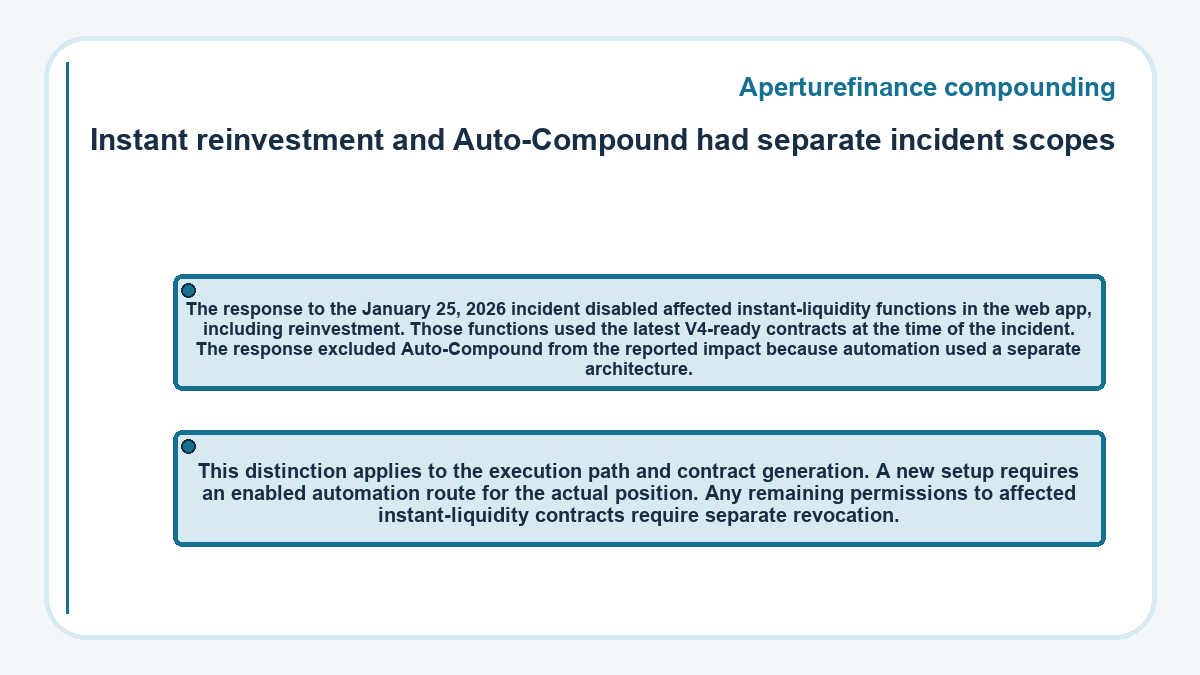
Instant reinvestment and Auto-Compound had separate incident scopes
The response to the January 25, 2026 incident disabled affected instant-liquidity functions in the web app, including reinvestment. Those functions used the latest V4-ready contracts at the time of the incident. The response excluded Auto-Compound from the reported impact because automation used a separate architecture. This distinction applies to the execution path and contract generation. A new setup requires an enabled automation route for the actual position. Any remaining permissions to affected instant-liquidity contracts require separate revocation.
Gas deductions and service charges reduce the reinvested balance
Net fee tokens determine how much capital compounding can add after execution and service costs. A gas ceiling bounds an allowed cost; it does not describe the full reinvestment deduction.
Network execution costs
Aperturefinance's liquidity-intent fee structure includes a network-specific gas surcharge to account for potential failed transactions. The published fee schedule also lists an approximate 3% reinvestment charge, without specifying the calculation base. In the gasless intent model, a solver pays the upfront network charge and recovers costs through token deductions. The relevant comparison uses accrued fees and the total charge for the intended operation, expressed on a consistent valuation basis.
Deductions from collected tokens
The UniV3 reinvest path deducts gas and Aperturefinance fees from the collected balances before adding liquidity. The deductions can involve either pool token. Preserve those token units when comparing the retained amount with the original fee balance. A percentage-based setting needs its stated calculation base, while a token deduction specifies an actual amount. Each supplied token amount sets that token's deduction, which the contract checks against its collected balance and the configured percentage limit. A pool's trading fee describes a separate cost.
The existing range determines the fee-token mix
Collected fees can arrive in proportions the existing position cannot fully use for additional liquidity. Reinvestment therefore includes a ratio adjustment through a swap where needed.
The documented UniV3 automation implementation calculates a swap to match the tokens to the position's range and pool conditions. It accounts for the swap's effect on token amounts. There is no universal equal-value split for every concentrated-liquidity position. Price bounds and pool price govern the required composition. Where a swap occurs, trading fees and price impact follow its actual execution route.
The first compound turns net fees into recorded liquidity
Consider a first compounding instruction for an enabled, supported UniV3 position with unclaimed fees and the required authorization. Keep its existing range unchanged. Once the accrued-fee threshold permits execution, compare the estimated gas charge with the selected ceiling.
When the fee and gas conditions allow an attempt, the stages below remain subject to authorization, deduction limits, slippage checks, and the transaction deadline. The UniV3 contract combines them within one reinvest call.
| Reinvest stage | Balance change | Limits and unused amounts |
|---|---|---|
| Collect fees and deduct charges | Collect owed pool tokens and subtract applicable deductions. | The call reverts if either token's deduction exceeds its collected amount or the configured share of that amount. |
| Adjust the token mix | Adjust net token proportions with a swap when needed. | The original price bounds remain unchanged. |
| Add liquidity | Increase liquidity in the same position using the adjusted amounts. | Return surplus value to the position owner. |
| Recorded outcome | Additional liquidity in the existing position. | A successful transaction and matching position state establish completion. |
After a successful compound, the expected observation is additional liquidity under the same position identifier. Compare that expectation with the successful transaction receipt and the position manager's recorded liquidity. The UniV3 automation contract also emits a Reinvest event for the position. A saved strategy or authorization signature alone establishes no liquidity increase. Token deductions and any returned surplus explain why the added capital differs from the gross fees collected.
With the same initial fee balance, a gas estimate above the saved ceiling leaves the instruction waiting. The gas estimate is a live input; the ceiling remains the chosen eligibility limit. Waiting preserves the cost limit, while increasing the ceiling accepts a higher possible execution deduction. The expected observation in this case is a waiting instruction without a successful reinvest transaction.
Fee accumulation governs compounding frequency
Auto-Compound links its reinvestment interval to earned fees and gas costs. Its controls accept minimum fee and maximum gas values in dollars or as percentages of the position. Those settings describe execution eligibility. They do not specify an interest rate. More frequent eligible reinvestments put fees into liquidity sooner and incur execution costs more often. Longer intervals leave fees unclaimed for more time between reinvestments.
Trading activity and the position's active range determine the supply of new fees. An annualized compounding projection needs assumptions about that revenue, costs, and future eligibility. A completed reinvestment supplies no fixed future yield.
Compounding leaves out-of-range liquidity inactive
A Uniswap V3 position earns no trading fees while the pool price sits outside its selected range. Adding liquidity to the same position preserves those bounds. Even a successful compound cannot, by itself, move an out-of-range position into a new interval. Fee tokens may remain available from earlier activity, so an unclaimed balance can coexist with inactive liquidity. Price returning within the range activates that liquidity again. A range change requires rebalancing, which carries different transaction inputs and costs.
Slippage and missing permissions bound execution
A reinvestment needs acceptable token amounts and the required position authorization, in addition to its fee conditions. Meeting the accrued-fee threshold alone does not satisfy the contract's other constraints.
Minimum token amounts
The UniV3 reinvest interface supplies minimum amounts for the two tokens used to increase liquidity. These minimums act as slippage checks and constrain the liquidity-addition result even after fee conditions permit an attempt. Pool conditions can move between estimation and execution, so an earlier simulation cannot fix the final token amounts. The reinvest call reverts if either token amount is below its minimum or the transaction executes after its deadline. That inclusion deadline applies to the prepared transaction; it does not establish a universal lifetime for every Auto-Compound strategy.
Position authorization
The automation contract needs authority to collect from the selected position through its position manager. An ERC-20 token allowance covers a different permission from an LP NFT authorization. Changing one leaves the other permission unchanged. Keep each permission tied to its actual contract and asset. If the requested authorization points to an affected instant-liquidity contract, stop before granting it. The incident response called for removing both token and position-NFT permissions granted to affected addresses.
Keeping fees liquid changes the next decision
Keeping fees unclaimed without an active compounding instruction postpones the reinvestment operation and its costs. Collecting fees to your wallet moves them into a separate balance and removes them from the position's unclaimed revenue.
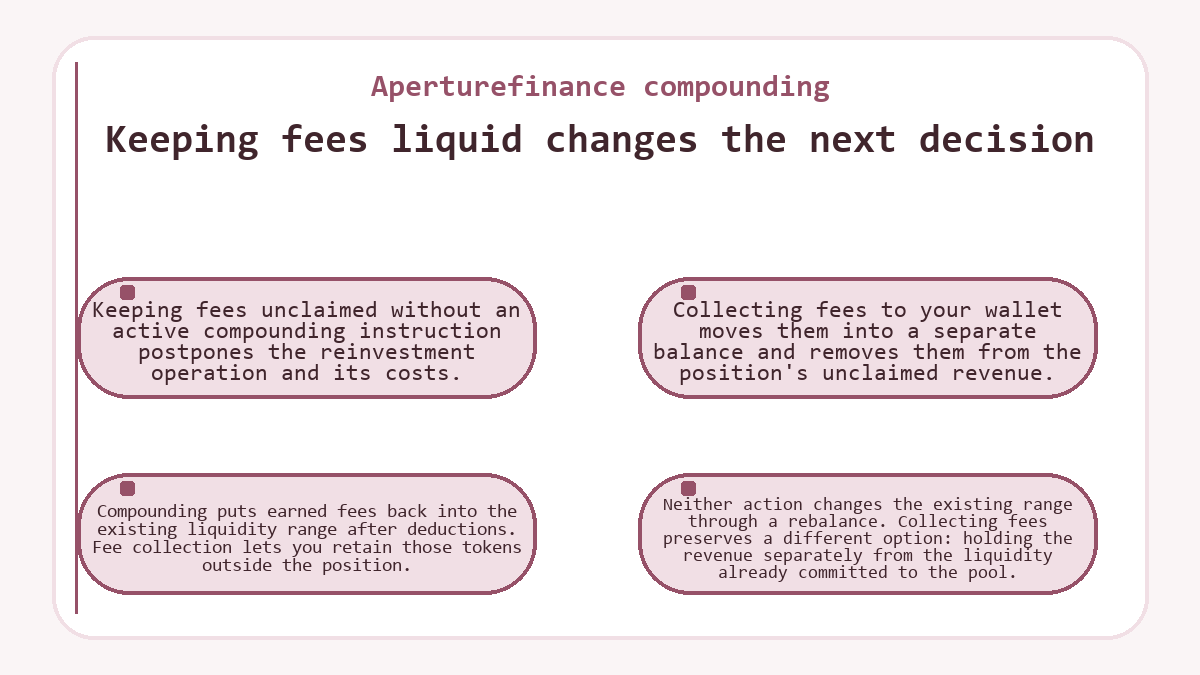
Compounding puts earned fees back into the existing liquidity range after deductions. Fee collection lets you retain those tokens outside the position. Neither action changes the existing range through a rebalance. Collecting fees preserves a different option: holding the revenue separately from the liquidity already committed to the pool.
Practical questions
Are fees already collected into a wallet eligible for the UniV3 reinvest operation?
The UniV3 reinvest operation uses fees still owed by the position. Returning wallet-held tokens to liquidity would be a separately funded add-liquidity operation, with its own availability requirements. Fees collected earlier therefore do not become unclaimed fees again merely because the wallet still holds those tokens.
Why can percentage-based compounding thresholds change without editing the strategy?
A threshold expressed as a percentage of position value changes its monetary equivalent when that valuation changes. Auto-Compound permits position-based percentages alongside dollar-denominated settings. Preserve the chosen basis when comparing accrued fees or gas with the threshold; changing token prices can alter eligibility without changing the saved percentage.
Can the Intents API prepare a reinvestment without sending it?
The published UniV3 integration example can populate a reinvestment transaction without broadcasting it. Its populate mode prepares the destination and encoded call data for later submission. That returned object does not record execution or added liquidity. An on-chain transaction must subsequently succeed before the position reflects the reinvestment.
Does holding an ERC-721 NFT make it eligible for UniV3 compounding?
UniV3 compounding requires a liquidity position issued by the matching position manager, with collectible fees and the required authorization. ERC-721 defines an NFT interface; it does not establish compatibility with a liquidity pool. The NFT contract and token identifier must refer to the actual supported position.
What separates APTR campaign rewards from the LP fees available for compounding?
APTR campaign allocations and a position's unclaimed trading fees represent separate balances. The APTR campaign reward basis was the fees users generated during its campaign period. UniV3 reinvestment collects the position's underlying pool tokens. A campaign allocation alone does not establish a collectible LP fee balance.