 Aperturefinance
 was built to automate concentrated liquidity through intents
Aperturefinance developed decentralized finance (DeFi) tools for managing concentrated liquidity, which places funds within a chosen trading-price range. Its principal functions included recurring rebalancing, scheduled position changes, and reinvestment of trading fees. The intent model expressed an action and its conditions for execution. A January 25, 2026 exploit affected contracts used for instant liquidity management. The response distinguished the affected instant-liquidity helper module from the separate infrastructure used for automation strategies.
Pool prices and position ratios shape liquidity actions
The liquidity toolkit used pool prices, position ratios, and scheduled times to determine when a configured action could become eligible for execution.
Market price and position composition
A pool price expresses one token's value in the other token in the pool. A position ratio describes the composition of that particular liquidity position. In concentrated liquidity, a liquidity provider (LP) chooses a price interval for the funds. Price movement changes the token composition and can move the position outside its active range. For Uniswap V3, out-of-range liquidity stops earning trading fees until price returns. Rebalancing changes the allocation and range; it does not remove market exposure.
Changing a range or ending a position
A rebalance generally removed liquidity, collected fees, exchanged tokens as needed, and added liquidity to a new position. Scheduled closure removed liquidity and returned the assets to the wallet. Price, ratio, and time conditions governed those actions within their respective implementations. USD-denominated price triggers are unsupported in the documented automation system. Pool-price conditions use the denomination of the selected token pair. The recurring-strategy interface also allowed different responses above and below configured thresholds.
How did intents connect a goal to execution?
In the AI roadmap, intents linked a declared outcome to proposed solver solutions and verification before execution, with separate components handling each responsibility.
Chatbot translation and structured instructions
The proposed chatbot converted natural-language goals into a domain-specific language (DSL), a structured notation for the requested action and constraints. The design returned a readable declaration for the user to review before signing. That declaration gave solvers an explicit description of the desired outcome.
Solver proposals and verification
The roadmap placed intents in an Intents Clearing House before solvers proposed solutions. Verification smart contracts would assess the proposed outcome, and a ranking and execution engine would select among verified solutions. It also described proof-based validation for cases relying on off-chain data. The product's solver network drew quotes from multiple solvers, including Propeller Heads and Enso. A structured declaration expressed the requested outcome; a solver proposal described a way to achieve it.
One-time moves, recurring strategies, and position closure
The documented LP toolkit offered one-time range moves, recurring rebalancing, and scheduled closure, each with a different effect on the position. Recurring strategies could begin with a new position or an existing one.
| Action | Trigger input | Position outcome | Execution constraint |
|---|---|---|---|
| One-time rebalance | Pool price, position ratio, or time | A single move to a configured new range | Gas ceilings or slippage limits can prevent execution |
| Recurring rebalance | Pool price or position ratio | Repeated range adjustments when conditions recur | Gas ceilings and minimum-output requirements still apply |
| Prescheduled closure | Pool price, position ratio, or time | Liquidity removal and return of assets to the wallet | The gas ceiling and any selected time buffer still apply |
| A matching trigger does not override configured cost limits or other execution conditions. | |||
Auto-compounding addressed accumulated trading fees, reinvesting them into the position after any required adjustment to the token ratio. Its controls included a minimum earned-fee amount and a maximum gas amount. Those conditions constrained when reinvestment could proceed. Compounding added fee revenue to liquidity, while rebalancing changed the position's allocation and range. Both operations could involve a token swap.
ApertureSwap and external DEX integrations had separate network scopes
The network map grouped support by decentralized exchange (DEX), so a listed blockchain did not imply identical automation features across every integration. Documented Uniswap V3 combinations included Ethereum, Arbitrum, Optimism, Polygon, Base, BNB Chain, Avalanche C-Chain, and Scroll. PancakeSwap V3 entries covered Ethereum and BNB Chain. Other documented integrations included Aerodrome and Velodrome. The public product also provided an application entry point and API documentation.
ApertureSwap was deployed on Manta Pacific as a concentrated-liquidity DEX modeled on Uniswap V3. This placed a project-native exchange alongside automation for external pools. The documented Manta Pacific implementation excluded recurring rebalancing. Instant-liquidity activity also appeared in the January incident response for Uniswap V3/V4 and PancakeSwap V3/Infinity. That affected-feature scope did not establish identical automation coverage across those versions.
Gasless intents still carry execution costs
The solver-funded gas model shifted the initial network payment to a solver and collected fees in tokens chosen by the user. The documented charging model included a network-specific surcharge to account for failed transactions. Network congestion and the work a transaction performed affected its gas cost. A configured gas ceiling could prevent an otherwise eligible automation action from executing. That limit controlled the permitted expenditure; it did not establish an execution deadline.
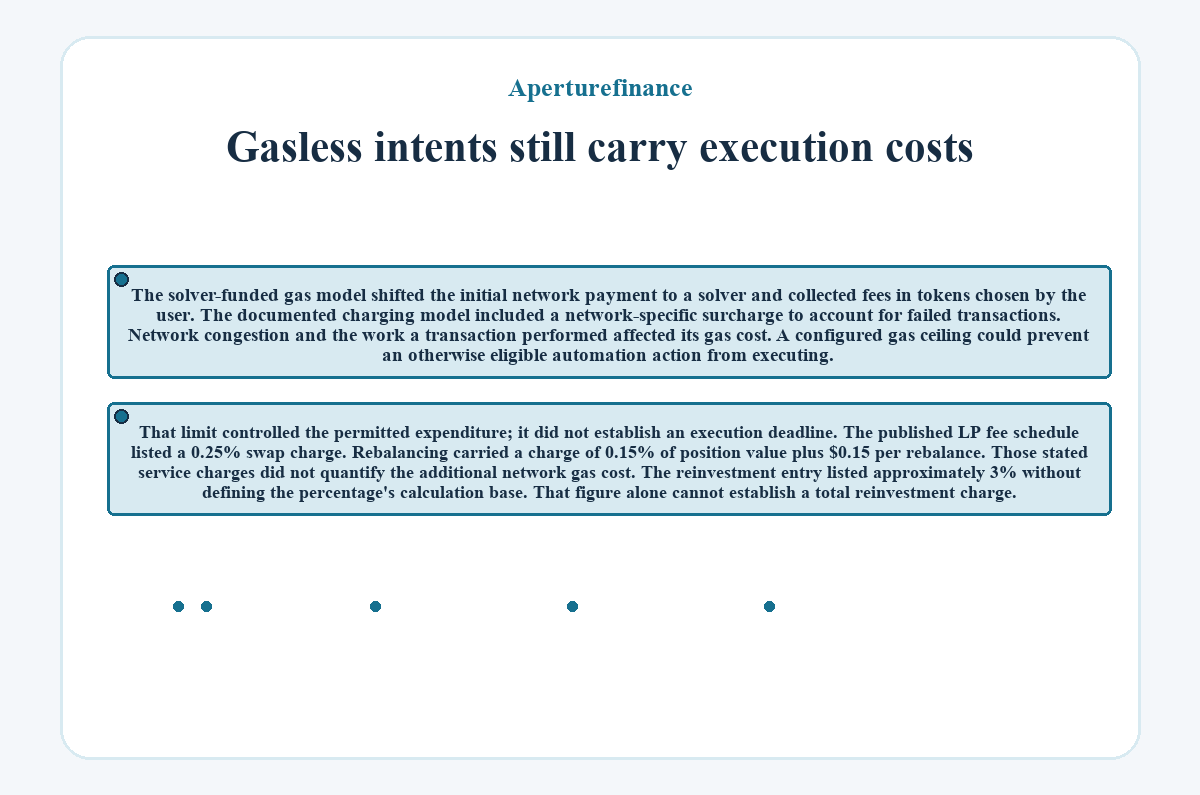
The published LP fee schedule listed a 0.25% swap charge. Rebalancing carried a charge of 0.15% of position value plus $0.15 per rebalance. Those stated service charges did not quantify the additional network gas cost. The reinvestment entry listed approximately 3% without defining the percentage's calculation base. That figure alone cannot establish a total reinvestment charge.
What did the January 2026 exploit actually affect?
The January 25, 2026 exploit abused approvals granted to instant-liquidity helper contracts, exposing ERC-20 tokens and approved Uniswap V3 liquidity-position non-fungible tokens (NFTs). The vulnerable path accepted attacker-controlled call targets and calldata, the encoded instructions accompanying a contract call. The affected native-token mint path was intended to wrap the asset, perform a swap, and mint a position. Insufficient validation in the swap call let attackers redirect execution toward assets the contract already had permission to move.
Estimated losses from the Aperturefinance incident totaled approximately $3.67 million across multiple chains.
Existing approvals supplied the authority for unauthorized transfers through
transferFrom
. Assets could remain in a user's wallet and still face exposure. The attack did not require each victim to sign a new transfer while it happened.
The affected contracts were closed-source. Technical analysis reconstructed their vulnerable behavior from deployed bytecode and on-chain execution traces. The lack of source code limited visibility into the original implementation.
The incident response disabled affected instant-liquidity functions and called for revoking approvals
In January 2026, the protocol disabled affected web-app functions and called for revoking permissions granted to the implicated contracts. The response identified instant minting, adding liquidity, and reinvesting on the affected V4-ready contracts. It also covered instant-liquidity activity involving Aerodrome and Velodrome. Disabling a frontend function stopped that entry path from accepting new approvals; existing on-chain permissions required separate action.
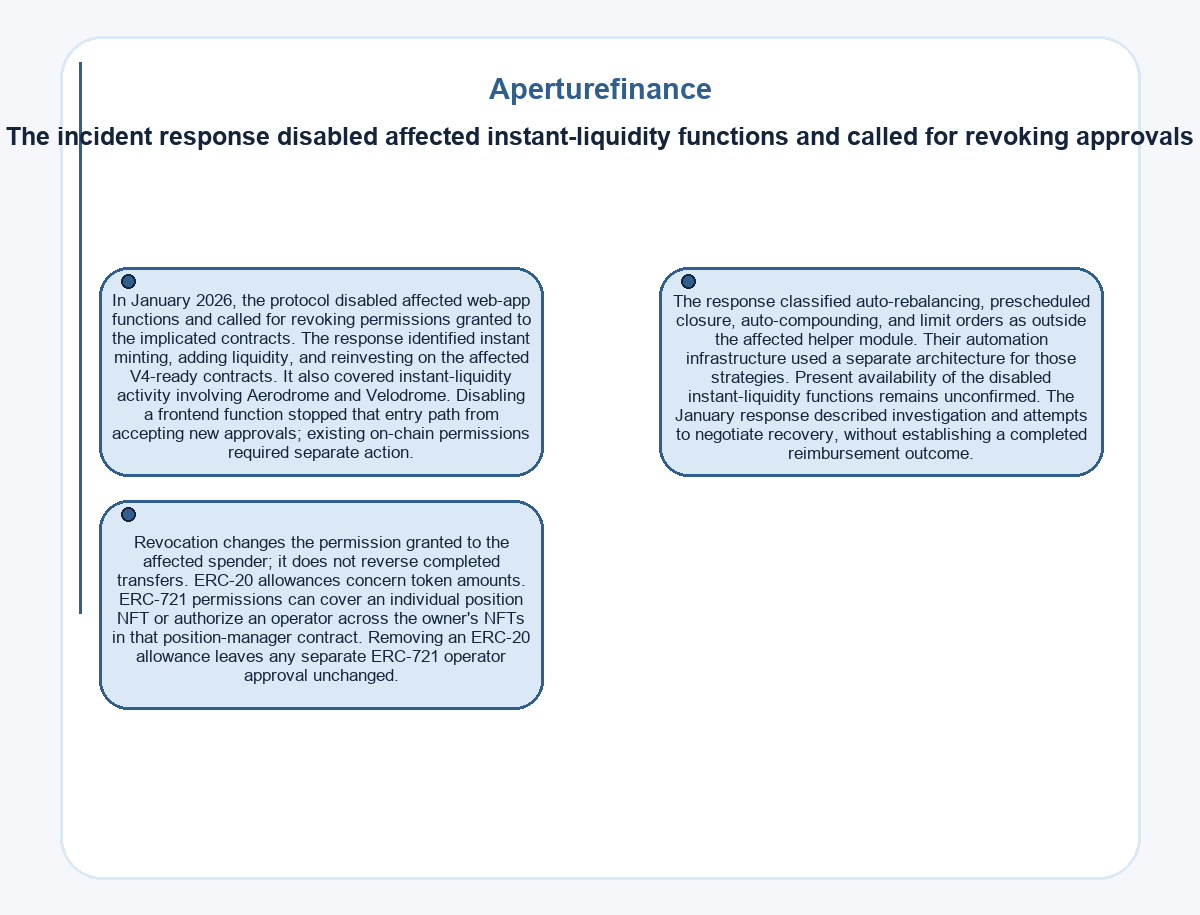
The response classified auto-rebalancing, prescheduled closure, auto-compounding, and limit orders as outside the affected helper module. Their automation infrastructure used a separate architecture for those strategies.
Present availability of the disabled instant-liquidity functions remains unconfirmed. The January response described investigation and attempts to negotiate recovery, without establishing a completed reimbursement outcome.
Revocation changes the permission granted to the affected spender; it does not reverse completed transfers. ERC-20 allowances concern token amounts. ERC-721 permissions can cover an individual position NFT or authorize an operator across the owner's NFTs in that position-manager contract. Removing an ERC-20 allowance leaves any separate ERC-721 operator approval unchanged.
Aperturefinance: reader questions
Does closing the browser cancel an Aperturefinance approval?
Closing the browser does not cancel an on-chain token allowance or NFT approval. Those permissions live in the relevant token contract, independently of the website connection. Removing an ERC-20 allowance or an ERC-721 operator permission requires changing the corresponding on-chain approval state.
How long did the documented one-time rebalance trigger last?
The documented one-time move-range trigger expired after 90 days. Execution still required its configured trigger and cost conditions to pass before that expiry.
Why could a configured price trigger remain idle after its target appeared?
A duration requirement, gas ceiling, or slippage limit could delay or prevent execution. The documented duration-based triggers waited at least the selected period, and updating a trigger restarted that wait. An instantaneous pool-price observation therefore did not establish readiness for a duration-based action. Separately, execution could fail its gas or minimum-output conditions.
Can a requested TWAP window exceed the pool oracle's stored history?
A requested time-weighted average price (TWAP) window can exceed the historical data stored by the pool oracle. In that case, the documented trigger system used only the available history. Low-volume pools could have fewer recorded observations. The selected duration therefore did not establish equally long historical coverage, even when the configured waiting period had elapsed.
What determines the gas ceiling for a scheduled position close?
The documented scheduled-close tool expressed its gas ceiling as a percentage of the managed position. It accepted a percentage or a dollar input, then converted a dollar input to that percentage basis. The setting limited the gas expenditure permitted for that action.
Will a completed rebalance retain the position's unclaimed fees?
The documented rebalance added unclaimed fees to the new liquidity position. It was distinct from scheduling auto-compounding, which configured reinvestment around earned fees and gas conditions.
Was the entire $17 million loss attributed to Aperturefinance?
The total exceeding $17 million combined the Aperturefinance and SwapNet incidents. The Aperturefinance estimate was approximately $3.67 million across multiple chains. Those figures describe different scopes and should not be substituted for one another. The incident estimate also does not establish an individual wallet's loss or the amount anyone ultimately recovered.